
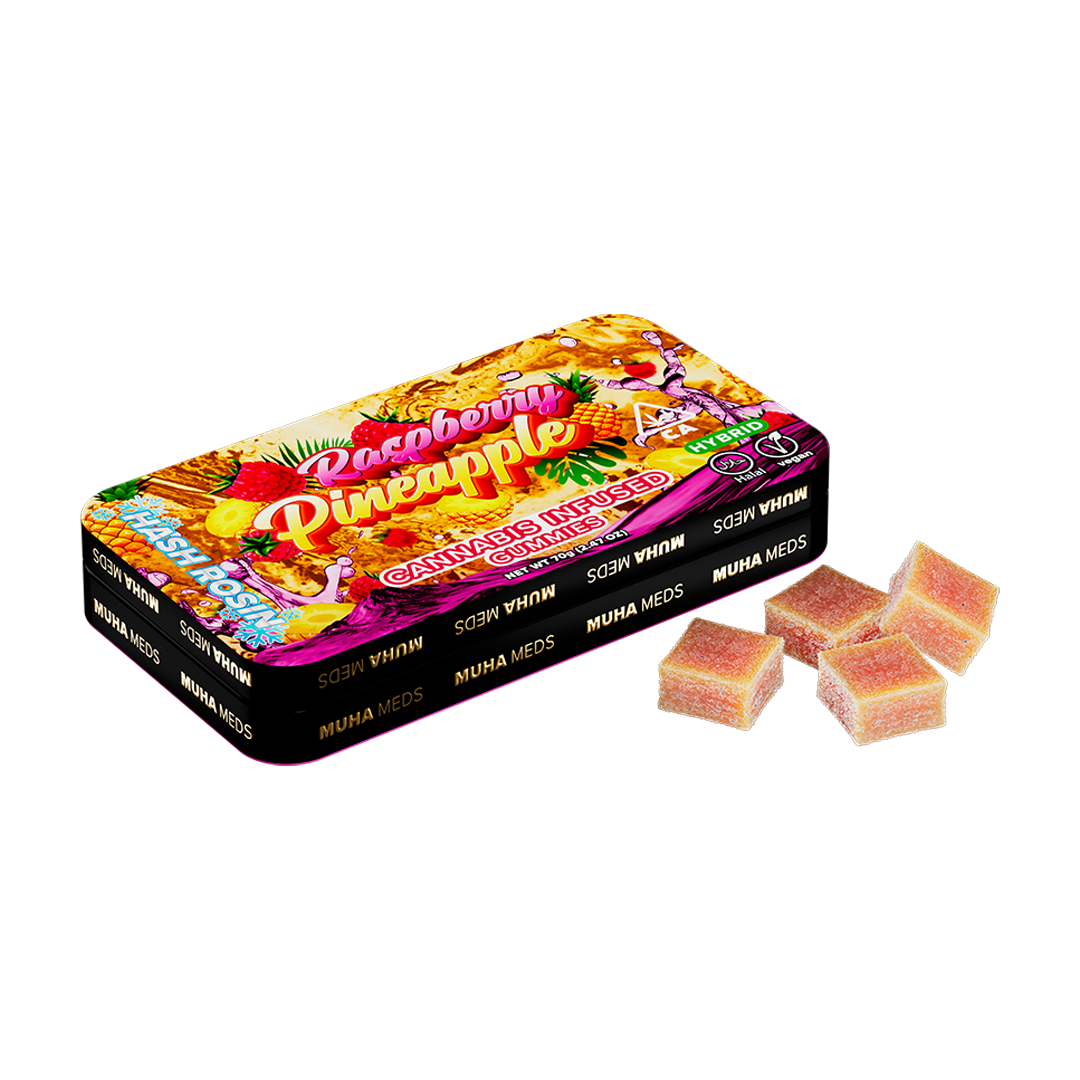
Muha Meds Raspberry Pineapple Hash Rosin Gummies are presented in packaging featuring raspberry and pineapple imagery, bright yellow and pink colours, and the words “Cannabis Infused Gummies.” The supplied image also displays a “Hybrid” designation and hash rosin branding. These visible details establish the product’s advertised identity, but they do not independently verify its ingredients, cannabinoid concentration, authenticity, or laboratory testing status.
The Raspberry Pineapple flavour name combines two familiar fruit profiles. Raspberry is commonly associated with a sweet and tangy fruit character, while pineapple is known for its tropical flavour profile. The actual flavour and ingredient formulation of this particular product should be confirmed using the manufacturer’s documentation rather than inferred from the packaging artwork.
The hash rosin designation identifies the type of cannabis concentrate represented by the product name. Hash rosin is generally produced using mechanical separation and pressure instead of chemical solvents during the extraction process. However, the designation alone does not prove the purity, strength, or quality of the finished edible.
For customers researching Muha Meds Raspberry Pineapple Gummies, an accurate product page should provide clear product identification, verified ingredient information, cannabinoid details, serving information, storage guidance, and relevant safety warnings.
At MuhaMedsFlavor.com, product information should be transparent and consistent with the item supplied. Retailers should verify product specifications, supplier documentation, and legal eligibility before publishing claims or offering regulated products.
Product Overview
The product shown in the supplied photograph is labelled Raspberry Pineapple and Cannabis Infused Gummies. The packaging also displays a Hybrid designation and hash rosin branding. These terms can be included in the product title when they match the verified product being sold.
A complete WooCommerce listing should provide customers with more than a product name and an attractive photograph. It should explain which specifications have been verified and identify any information that still needs confirmation.
Product identification details
- Brand shown: Muha Meds
- Flavour shown: Raspberry Pineapple
- Product type shown: Cannabis-infused gummies
- Formulation designation shown: Hash rosin
- Classification shown: Hybrid
- Package quantity: Confirm from the original label
- Cannabinoid content: Confirm from the actual product label
- Ingredients: Obtain the complete manufacturer ingredient statement
- Laboratory testing: Verify using a report for the relevant batch
- Storage requirements: Follow the manufacturer’s instructions
- Legal availability: Subject to applicable laws and restrictions
These specifications should be checked against the exact product and batch before the listing is published. Similar packaging or product names do not guarantee identical formulations.
Raspberry Pineapple Flavour Profile
Raspberry Pineapple is a fruit-inspired flavour designation that combines the familiar characteristics of raspberries and pineapples. Raspberry is commonly associated with a sweet-tart flavour, while pineapple is associated with tropical fruit notes.
Together, the two fruit names communicate the intended flavour identity of the product. The actual flavour experience, however, depends on the formulation used by the manufacturer. Product photographs cannot establish whether real fruit, fruit juice, natural flavourings, artificial flavourings, or other ingredients are present.
Customers with dietary restrictions or food allergies should consult the complete ingredient label. The retailer should not assume that a fruit name means the product contains a particular amount of real fruit or is free from artificial additives.
A useful product page can include a readable photograph of the ingredient panel alongside the main packaging photograph. This gives customers an opportunity to review the information printed on the actual product before making decisions.
Retailers should avoid unsupported claims such as organic, natural, sugar-free, vegan, gluten-free, or allergen-free unless the manufacturer’s documentation supports them.
Understanding the Hash Rosin Designation
Hash rosin is a cannabis concentrate generally produced by applying heat and pressure to prepared cannabis material. Its production is commonly described as solventless because the extraction method does not rely on chemical solvents in the same manner as some other concentrate-production methods.
The term describes an extraction approach, not a complete guarantee about the finished product. A hash rosin-labelled edible may contain other ingredients, and the product’s complete composition must be determined from its ingredient statement and appropriate laboratory documentation.
The extraction method alone does not establish the final cannabinoid concentration, the absence of contaminants, or whether the product complies with applicable regulations.
For this reason, the retailer should use the hash rosin designation only when reliable product information supports it. A product description should not claim that the finished gummies are completely pure, chemical-free, or independently verified solely because hash rosin appears in the product name.
Customers seeking detailed information should review the product’s verified specifications and any available batch-specific certificate of analysis.
For general information about cannabis and related research, consult the National Institute on Drug Abuse.
Understanding the Hybrid Label
The package shown in the image displays the word “Hybrid.” This should be treated as a product classification printed on the packaging rather than a guarantee of a particular effect.
The word alone does not establish the product’s cannabinoid profile, composition, or the experience an individual may have. Cannabis products can vary in chemical composition, and individual responses may also differ.
A responsible product page should therefore distinguish between the manufacturer’s classification and verified analytical information. If the manufacturer provides supporting documentation, the retailer may describe the classification in accordance with that documentation.
The listing should not promise specific effects, medical benefits, or a predictable response based solely on the Hybrid designation.
Cannabinoid Content and Serving Information
Cannabinoid content is an important part of understanding a cannabis-infused edible. Nevertheless, the exact amount contained in a package cannot be established from the supplied photograph.
Before publishing numerical product specifications, the retailer should confirm the original label and relevant supplier documentation.
Important information includes:
- The cannabinoid types identified on the package.
- The stated amount per individual gummy, where applicable.
- The total cannabinoid amount per package.
- The serving size and number of servings.
- Any applicable product warnings.
- The batch or lot reference associated with testing records.
If the manufacturer states a particular amount per gummy, the product page should reproduce it accurately and distinguish it from the total amount in the package. All calculations should be checked against the actual label.
The product’s Raspberry Pineapple flavour, hash rosin designation, and Hybrid classification cannot substitute for this information. Customers should not infer strength from the number, colour, or appearance of the gummy pieces.
Where cannabinoid information is unavailable, the listing should state that the specifications require confirmation rather than inventing a numerical value.
Ingredients and Allergen Information
A complete ingredient statement helps customers make informed choices and assess whether a product is suitable for their dietary needs. The packaging photograph supplied does not provide a readable, complete ingredient list.
The retailer should obtain the original ingredient panel or written manufacturer documentation before adding detailed ingredient claims.
The product page should address the following details when verified:
- The sweeteners and sugars used.
- The gelling agents, such as gelatin or pectin, if present.
- The flavourings and acidity regulators.
- Any preservatives and colouring agents.
- The cannabis-derived ingredients.
- Declared allergens and cross-contact warnings.
- The storage instructions and expiration or best-before date.
Customers with allergies should read the complete label and contact the manufacturer when relevant information is missing.
Retailers should not assume that a raspberry or pineapple flavour designation proves the presence of real fruit. Similarly, the presence of plant-derived ingredients does not automatically make a product suitable for every dietary preference.
Accurate ingredient information is particularly important for a product marketed as confectionery because its appearance may resemble ordinary sweets.
Laboratory Testing and Certificate of Analysis
A certificate of analysis, commonly called a COA, is a laboratory document reporting the results of testing on a particular sample. Depending on the laboratory and scope of the analysis, it may include cannabinoid measurements and screening for selected contaminants.
A laboratory report must be relevant to the exact product being described. A report for another flavour, formulation, or batch should not automatically be used to support claims about these Raspberry Pineapple Gummies.
Before publishing a laboratory-testing claim, check the following:
- The laboratory’s identity and relevant qualifications.
- The product and sample identification.
- The batch or lot reference, where provided.
- The sample and testing dates.
- The cannabinoid results and measurement units.
- The contaminant categories included in the report.
- Any limitations stated by the laboratory.
A COA does not automatically establish that a product is entirely safe or suitable for every individual. It reports findings within a particular testing scope and applies to the sample identified in the document.
If a matching report is available, the retailer may link to the genuine document after confirming its relevance. If the report cannot be verified, the product page should not display an unsupported laboratory-tested badge.
For general regulatory background, visit the US Food and Drug Administration’s cannabis product information.
Product Authenticity and Supplier Documentation
A product photograph alone cannot establish that an item is genuine. Branded packaging and printed logos are useful identification details, but authenticity should be supported by traceable sourcing and reliable records.
Retailers should retain supplier invoices, manufacturer information, batch details, and applicable compliance documents. If the manufacturer offers an official product-verification system, the retailer should confirm that the system is genuine and that the returned information matches the item.
A QR code or printed identifier should not be described as proof of authenticity until it has been checked against a reliable source.
Retailers should also avoid claiming official authorisation, verified origin, manufacturing compliance, or independent authentication unless appropriate evidence supports the statement.
If the product identity or supplier documentation cannot be confirmed, the listing should remain unpublished until the relevant information is resolved.
Transparent sourcing practices help customers distinguish documented product information from assumptions based on packaging or brand presentation.
Packaging and Product Photography
The supplied image uses yellow, pink, and fruit-themed artwork to highlight the Raspberry Pineapple flavour. It shows a rectangular tin with branding around the sides and individual gummy pieces beside the package.
The image is useful for product identification, but it does not reveal all the information customers need. A strong WooCommerce gallery should include the main product image and, where available, readable photographs of the original ingredient panel, cannabinoid information, warnings, and batch identification.
Product photographs should accurately represent the item supplied. Retailers should not use a photograph of one package variation to represent another if the labels or specifications differ.
Images should be compressed appropriately for website performance while retaining sufficient clarity to show the packaging. Descriptive filenames and accurate alternative text can improve accessibility and help search engines understand the image.
Suggested image filename: muha-meds-raspberry-pineapple-hash-rosin-gummies.webp.
Suggested alternative text: “Muha Meds Raspberry Pineapple Hash Rosin Cannabis Infused Gummies Hybrid packaging.”
Alternative text should describe the image rather than repeat a list of search keywords.
Storage and Handling Guidance
Cannabis-infused gummies require careful storage because their appearance may resemble ordinary confectionery. Accidental ingestion can be dangerous, particularly for children.
Follow the manufacturer’s storage instructions and keep the product in its original packaging. Store cannabis edibles in a locked, child-resistant container and out of the sight and reach of children and pets.
Avoid transferring the gummies into unmarked containers or placing them alongside ordinary sweets. Keep product identification, serving information, and warnings available.
Temperature and moisture can affect confectionery products, so the correct storage conditions and shelf life should be taken from the actual label. Do not invent a specific temperature range or expiration period when the manufacturer has not provided one.
For additional information about accidental ingestion and cannabis-related health risks, consult the CDC cannabis poisoning guidance.
Responsible Use and Consumer Safety
Cannabis edibles can have delayed and prolonged effects. The time before effects are noticed varies, and a product’s appearance or flavour cannot predict its strength.
The Centers for Disease Control and Prevention warns that edible cannabis products can cause poisoning, including serious illness in children who accidentally consume them.
Customers should follow applicable medical and legal guidance and should not consume additional amounts simply because they do not immediately notice an effect. Cannabis can impair attention, coordination, reaction time, and decision-making. Anyone who may be impaired should not drive or operate machinery.
Cannabis use is not recommended during pregnancy or breastfeeding. People who take medication or have concerns about potential interactions should consult a qualified healthcare professional.
Retailers should make relevant warnings clear and accessible. Product safety information should not be hidden behind promotional text or replaced with statements that suggest an edible is harmless because it resembles candy.
For general information, consult the CDC’s cannabis health and safety guidance.
Legal and Regulatory Considerations
The rules governing cannabis-infused edibles vary by jurisdiction. Requirements may cover permitted cannabinoid content, product formulation, labelling, manufacturing, age verification, advertising, licensing, possession, importation, and delivery.
Before listing this product for sale, the retailer should determine whether the item can lawfully be offered in the intended market. A brand name or product classification does not establish legal eligibility.
Where required, retailers should verify supplier authorisations, applicable business licences, product documentation, age restrictions, and destination-specific shipping rules.
Claims that a product is legal everywhere or available for unrestricted international delivery should not be published without reliable legal and operational confirmation.
The product page should distinguish between general product information and verified purchase eligibility. If the product cannot lawfully be offered in a particular jurisdiction, the retailer should not facilitate an unlawful transaction.
Regulatory information should be reviewed periodically because laws and product requirements can change.
Customer Information and Transparent Product Listings
A well-organised product page helps customers locate important information without relying on exaggerated promotional statements. The product name, visible label details, ingredient information, serving specifications, warnings, and relevant laboratory documents should be easy to find.
If different formulations or package sizes exist, each variation should have accurate specifications. Information from one product should not automatically be reused for another merely because the packaging looks similar.
A clear contact page and accurate store policies also help customers identify the seller and understand how to ask questions about product documentation.
The retailer should publish only the claims that can be supported by reliable evidence. Where information remains unavailable, the listing should state that it needs confirmation.
For the Muha Meds Raspberry Pineapple product, the most important remaining verification points are the complete ingredient list, package quantity, cannabinoid content, batch-specific testing documentation, and applicable legal requirements.
Frequently Asked Questions
What is Muha Meds Raspberry Pineapple Hash Rosin Gummies?
The supplied packaging identifies the product as Raspberry Pineapple Cannabis Infused Gummies and displays hash rosin branding. The exact composition and specifications should be confirmed using the original label and supplier documentation.
What flavour is shown on the package?
The package is labelled Raspberry Pineapple. The precise flavouring ingredients should be checked against the manufacturer’s ingredient statement.
What does hash rosin mean?
Hash rosin is a cannabis concentrate generally produced using mechanical separation and pressure rather than chemical solvents during extraction. The term alone does not verify the finished edible’s purity or laboratory status.
What does Hybrid mean on the packaging?
Hybrid is the classification displayed on the package. It should not be treated as a guarantee of a particular effect or a substitute for verified cannabinoid information.
How many gummies are in the package?
The supplied image does not establish the total package quantity. Confirm the quantity from the original label before publishing it in WooCommerce.
How much cannabinoid does each gummy contain?
The amount cannot be confirmed from the photograph. Use the actual product label and, where available, a matching certificate of analysis.
Is the product independently laboratory tested?
Testing status has not been established by the supplied image. A current, verifiable report matching the exact product and batch is needed before making this claim.
Are the ingredients suitable for people with allergies?
That cannot be confirmed without the complete ingredient and allergen statement. Customers should review the label and contact the manufacturer if information is missing.
How should cannabis gummies be stored?
Follow the manufacturer’s directions and keep the product in a locked, child-resistant container away from children and pets.
Can the product be shipped internationally?
No universal shipping claim should be made. Availability depends on the product’s verified composition, applicable laws, seller authorisations, and destination restrictions.
Where can customers find additional product information?
Customers should consult the complete product label, relevant supplier documents, applicable safety guidance, and the retailer’s genuine website policies.
Final Product Information Notice
This description provides general product-identification information based on the supplied packaging image. It does not independently verify authenticity, cannabinoid content, laboratory testing, product safety, or legal availability.
All numerical specifications, ingredients, manufacturer claims, and laboratory results should be confirmed against reliable documentation for the exact product and batch. Unsupported claims about potency, purity, medical benefits, or testing should not be published.
For additional background on cannabis edible risks, consult the CDC’s cannabis poisoning guidance and the FDA’s cannabis product information.
For general website information, visit MuhaMedsFlavor.com.
Reviews
There are no reviews yet.